
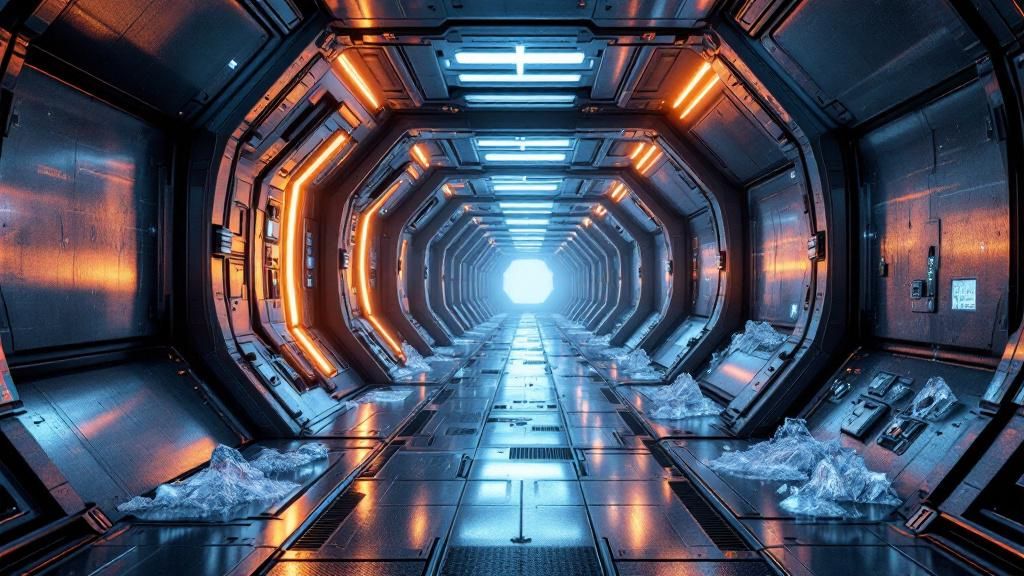
Supermassive Games has announced a comprehensive PlayStation 5 Pro upgrade for its horror narrative title Directive 8020, launching on 12 May 2026. The improvement leverages the console’s advanced hardware capabilities, encompassing PlayStation Spectral Super Resolution (PSSR), ray-traced rendering, and dynamic shadow rendering to elevate the cinematic storytelling experience. The upgrade delivers crisper imagery, more realistic lighting, and enhanced atmospheric detail throughout the perilous operation aboard the Cassiopeia as the crew works to endure an encounter with a morphing extraterrestrial entity. According to Will Burdon, Technical Director at Supermassive Games, the improvements deepen the tension and emotional resonance that sit at the heart of the game’s choice-driven narrative.
Horror Cinema Reinvented for Modern Gaming Hardware
Directive 8020 was created from the start as a narrative-driven cinematic journey, prioritising atmospheric storytelling and meaningful player choice above all else. The PlayStation 5 Pro upgrade allows Supermassive Games to achieve this vision with unprecedented visual fidelity, displaying each scene with greater detail that underscores the emotional resonance of critical moments. Character portrayals, facial expressions, and environmental narrative now gain from the console’s enhanced graphical capacity, creating a more immersive experience where subtle visual details are vital to the storytelling. When players need to choose which character to trust—particularly when faced with identical appearances—these nuanced upgrades in character presentation are vital to the sense of horror.
Lighting has traditionally served as one of the most potent horror storytelling tools, and the PS5 Pro enhancements intensify this dramatically. Sophisticated ray-tracing technology enables light to exhibit realistic precision, reflecting smoothly through metal passageways and reflecting off surfaces with genuine realism. Emergency strobes illuminate bulkheads whilst firelight flickers dynamically faces, producing shifting shadows that move erratically throughout spaces. This enhanced visual fidelity converts the Cassiopeia from a static backdrop into an immersive environment where peril waits in every shadow, intensifying the tension that permeates the whole gameplay.
- Ray tracing produces realistic lighting and shadow behaviour across corridors
- PSSR technology improves environmental details and character model sharpness
- Dynamic shadows introduce depth, movement, and unpredictability to scenes
- Enhanced facial animations increase emotional resonance during critical narrative moments
Aesthetic Improvements Driving Environmental Suspense
AI-Powered Precision Through PSSR Technology
PlayStation Spectral Super Resolution (PSSR) represents a major step in graphical display for Directive 8020. Sony’s AI-driven upscaling technology intelligently enhances visual sharpness and definition on a individual frame approach, altering how players observe the Cassiopeia and its threatening setting. The metallic corridors now shine with sharp clarity, whilst contextual features that reveal the narrative of the ship’s critical condition emerge with newfound sharpness. In-game figures gain similarly from this refinement, enabling subtle expressions and details to manifest with heightened exactness.
The frost accumulating on the medical laboratory’s surfaces and the distortion seen in reflective visors exemplify how PSSR enhances the game’s visual language. These environmental details, though seemingly minor, contribute substantially to the immersive horror atmosphere Supermassive Games has crafted. By refining visual clarity throughout each scene, PSSR ensures that players absorb every carefully constructed detail, strengthening their bond to the narrative and heightening their sense of vulnerability aboard the doomed vessel.
Advanced Ray Tracing and Dynamic Lighting
Advanced ray tracing fundamentally transforms how light behaves within Directive 8020’s settings. Light now travels realistically through passages and reflects genuinely off steel surfaces, creating a sense of physical credibility that establishes the terrifying atmosphere. Emergency strobes glow authentically against walls, casting harsh, flickering shadows that perplex and trouble. Firelight moves fluidly across the faces of characters, whilst ice splits light in fashions that appear genuinely cold and severe, strengthening the hazards of the setting beyond the extraterrestrial threat itself.
This realistic lighting behaviour performs a crucial narrative purpose within the game’s tension-building framework. By creating lighting that demonstrates physical reality, players cultivate an intuitive understanding of their setting, making the mysterious hazards lurking in darkness all the increasingly menacing. The relationship between illuminated spaces and darkness generates constant visual uncertainty, ensuring that no hallway feels entirely safe or comprehensible, perpetually fuelling the oppressive atmosphere that characterises the experience.
Shadowy Elements as Storytelling Device
Shadows serve as far more than mere visual decoration in Directive 8020; they constitute a core vocabulary of fear woven throughout the experience. Detailed dynamic shadows contributes unprecedented depth and motion to scenes, reshaping static environments into uncertain territories where danger could emerge at any moment. A moving shadow form might be nothing—or it might be the alien hunter watching from the darkness. This refined shadow technology generates quiet yet deeply affecting mood intensification, intensifying the pervasive unease that marks every moment aboard the Cassiopeia.
Operational Speed and Reaction Time in Time-Sensitive Scenarios
In a story-driven journey where every decision carries weight and consequences ripple throughout the story, frame rate consistency proves essential to the gameplay experience. The PlayStation 5 Pro upgrade ensures that Directive 8020 maintains consistently smooth frame rates during the most intense moments, ensuring no technical glitch from breaking immersion during critical story choices. Whether traversing the cramped passages of the Cassiopeia or confronting the mimicking alien threat, players can rely on responsive controls and fluid visuals that remain steady when pressure intensifies, allowing them to focus entirely on the narrative choices that determine their fate.
This enhanced technical consistency demonstrates especially worthwhile during sequences demanding instantaneous responses or situations where user decisions substantially changes the story’s trajectory. The improved system eradicates frame rate dips that could otherwise undermine character dialogue, world-building details, or the mounting dread of pursuit. By ensuring stable technical delivery, the PS5 Pro enhancement guarantees that every pivotal decision appears cinematic and consequential, with no performance compromise weakening the emotional resonance of the storytelling experience or the player’s agency within the evolving narrative.
- Consistent frame rates preserve immersion during high-tension decision sequences
- Responsive controls deliver exact player input during critical story moments
- Stable performance eliminates technical interruptions from narrative impact
DualSense Integration and Immersive Gameplay
The PlayStation 5 Pro enhancement extends beyond visual enhancements to fully leverage the DualSense controller’s cutting-edge haptic sensations and adaptive trigger capabilities. These tactile features transform Directive 8020 into a profoundly immersive experience, enabling gamers to sense the stress and threat on the Cassiopeia. Every noise resonating down steel hallways, every heartbeat during moments of suspense, and every contact with the setting translates into detailed haptic responses that erase the distinction from display to controller, deepening emotional engagement to the plot.
The adaptive triggers introduce another level of immersion, delivering contextual resistance that mirrors the physical actions users execute within the game world. Pulling a door handle necessitates progressive resistance, whilst using implements or armaments generates interactive sensations that shifts based on world state and plot developments. This refined tactile system ensures that decision-making moments appear weighty and significant, with the DualSense becoming an extension of the player’s agency rather than merely a peripheral device, substantially improving how players connect with their survival aboard the doomed spacecraft.
| Feature | Immersive Effect |
|---|---|
| Haptic Feedback Vibrations | Players physically feel environmental dangers and character emotions through precise controller vibrations |
| Adaptive Trigger Resistance | Contextual pressure feedback mirrors in-game actions, making interactions feel authentically grounded |
| Heartbeat Simulation | Rhythmic haptic pulses synchronise with character anxiety, amplifying psychological tension during critical moments |
| Environmental Tactile Cues | Dynamic feedback responds to surroundings, alerting players to nearby threats through subtle controller sensations |
Through this sophisticated DualSense integration, Supermassive Games transforms Directive 8020 into a multisensory experience where visual narrative, sound design, and tactile feedback blend together. Players transcend the role of passive observers of the crew’s desperate struggle for survival—they viscerally experience it, with every haptic vibration intensifying the escalating tension and desperation that defines their journey through the frozen depths of space.
The vessel named Cassiopeia Stands Ready
Directive 8020 sends players aboard the ill-fated Cassiopeia, a spacecraft bound for Tau Ceti f on a mission that quickly transforms into a battle for survival. The vessel acts as far more than mere backdrop—it’s a character in itself, with every passageway, lab, and viewing area precisely constructed to amplify the psychological horror of being pursued in the infinite void of space. The PlayStation 5 Pro upgrades breathe new life into these restricted areas, presenting the ship’s metal exterior with remarkable detail and authenticity that makes the enclosed atmosphere feel authentically ominous.
The crew’s predicament intensifies when an extraterrestrial entity capable of perfectly mimicking its victims penetrates the Cassiopeia, forcing players to question every encounter and alliance. With advanced ray tracing technology casting authentic shadows through corridors and adaptive lighting generating unpredictable visual environments, tension permeates every second aboard the ill-fated ship. The upgraded visuals ensure that minor environmental cues—frost accumulating on windows, distortions in visors, the flicker of emergency lighting—serve as vital narrative devices that amplify fear and unease throughout this cinematic story experience.
